Dear Friends,
Have you noticed yourself looking for structures that might infringe on your autonomy?
Have you noticed yourself looking for structures that might infringe on your autonomy?
Think of those signing up for yoga teacher training who don’t actually want to teach yoga. Or the growing number of men’s accountability groups and new moon circles. Or hearing Reddit’s co-founder explain that internet users are abandoning large social networks in favor of more bounded messaging platforms?
Everywhere in our lives we are flooded with content.
But we have few containers in which to make meaning of it.
Robert Bellah’s astonishing essay ‘History and Habit’ explains why. Recommended by my friend Rabbi Scott Perlo and his teacher Reb Shmuel Lewis, Bellah draws out one of the most important design question for any community leader today.
He starts by introducing two permanent polarities of human action:
- Habit (positional control)
- Individual initiative (personal control)
Both are systems of control. The first depends on a social pattern. When a child asks, why they must do a thing, the answer is in terms of a relative position. “Because you’re a child” (age status.) “Because you’re a girl” (gender status.) “Because you’re the eldest” (seniority.)
The second depends on autonomy and unique value. When the child asks, the parent responds with as full an explanation as they can offer. The curiosity of the child is encouraged and they are made to understand the sensitivities of other people’s feelings. “Because I’ve got a headache.” “Because your father’s feeling worried.” Here, control isn’t mediated through rigid positions, but instead through verbal manipulation of feelings and abstract principles. Note: it can be just as coercive!
In this second model, “Ideas about morality and the self get detached from the social structure.” That is often liberating! When structures oppress us, we need to tear them down.
But, living without positional control, we do not have enough personal capacity to live as we want to, relationally. “It is not that children raised in such a milieu lack ethical ideas; sensitivity to the feelings of others can arouse strong ethical passions when others are observed to be suffering. The problem is that without some positional sense of social membership and without strong condensed symbols, ethical sensitivities may simply dissipate into good intentions without leading to sustained moral commitments.”
A positional society has clear boundaries and well-defined roles. Think of the military or most monastic orders. Individuals have a strong social location and identity in relationshipto others. Repeated ritual condenses the codes of meaning. People know how to behave ethically.
But a personal society, amidst its freedoms, has loose connections and porous boundaries. It lacks well-defined roles. Individuals have to relate to each other more, without clear guidance of when and how, and using elaborate speech to communicate much more information. There’s little shared ritual or symbolism. Though able to express our individuality and pursue our chosen principles, we find little meaning.
In 2019, most of us live in a culture of personal control. And it is exhausting.
So what now?
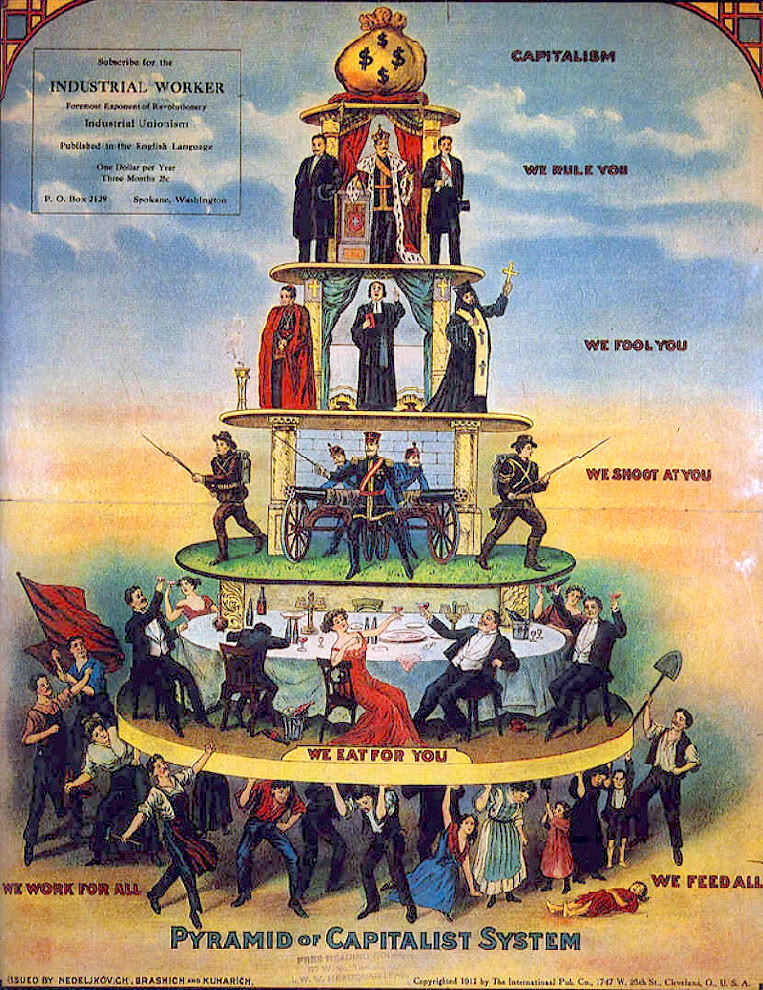
Clearly, we don’t want to return to some positionally-defined feudal society, nor further entrench our stratified system of class/race/anything else hierarchy (see the 1912 Industrial Worker cartoon, above.)
Bellah also denies that returning to traditional religious congregations is an option. “To what extent are religious communities in America still sufficiently strong as communities to understand the condensed code of their own traditions, or to what extent has the world in which we live so invaded and eviscerated those communities that they have difficulty understanding their own core meanings?”
But neither will our “flexidoxy” culture of unbundling and remixing practices and identities do the job either. We have been so shaped by consumer capitalism that our commitment lasts only as long as it meets our personal needs. And that will never be the foundation for a strong community, nor provide the meaning we so hunger for.
The task before us is then inherently creative; to somehow re-bundle. We need new containers of commitment in which we can make meaning. Ideally, containers that critically reappropriate existing condensed codes rather than making things up out of thin air. (This is what you’ll recognize in our pilots like the Formation Project and the Advent Project.)
These containers need to be safe enough to earn our trust, high-bar enough to make a clear distinction between in/out group, and transformative enough that we continue to allow others to depend on us – and even trickier – to “give up the illusion of absolute autonomy and recognize that we are related to, even dependent on, others.”
Bellah’s essay is worth a read this weekend. Among various other sparklets, he has much more to say about meaning and ritual. (As an aside, Kursat Ozenc from Stanford’s Ritual Design Lab has a new book on ritual in the workplace that I’m excited to read.)
Throughout, I was reminded of my old professor Marshall Ganz who teaches his students that when organizing people, we shouldn’t try and make things easy. We should make them meaningful.
Have a wonderful weekend, Shabbat Shalom,

 Dusty Bookshelves