Nonna and I lived together at my parents’ house one summer. I was still in the thick of college, and back then, 11:00 a.m. seemed to me like too early a time for everything but sleeping — especially something like the disruption of a loud television right above where I slept in my basement bedroom. Most mornings, though, Nonna couldn’t last that long without the excitement that the noise gave her day. I would come upstairs, hair and pajamas both disheveled and eyes squinting from natural light, greeting both Nonna and the loud dramas of Italian soap operas coming from the TV with a sleepy resignation.
Almost every morning was the same: Nonna sitting on a chair in the family room, perched with her back upright, hands interlocked and brow peaked in polite attention to the lives of people she didn’t know. In her very Nonna voice, she would exclaim my name: replacing the “i” with three “e”s and dropping the “h.”
“Good morning, Teeemoty.”
In one of our bleary-eyed good mornings, she walked with me to the kitchen and offered me a tiny cup of Italian coffee she had just prepared. This was my introduction to espresso, which I would later bring back to school with me to the delight of my always-exhausted friends during the sleepless nights of finals week. She placed the two little mugs on the kitchen table; offered me a spoonful of sugar; and as we stirred it into our drinks, began to tell me about her life in Italy. Out of all the things she told me, the one that sticks out from that day is the way she described meeting my grandfather, my Nonno.
She first met him when she was young, at an annual dance that her mother would bring her to when she was a kid. He was a stranger to her when he first approached her to ask her onto the floor. She didn’t have to look toward her mother for a validation of her own disapproval, before she turned her cheek on my grandfather. As he held his hand out, awaiting an answer, her denial was as obvious as the stains on his upturned palm. The mark of his manual labor was enough to disinterest her.
And she told me that’s how it was every year: he’d approach her, she’d deny him. Until one year, she didn’t recognize the extended arm before her. The hands were as clean as the crisp military officer’s uniform that it was attached to, and she didn’t have to say anything before she followed him where he led.
She told me that it was Nonno’s hands that made her fall in love.
Almost as if following her lead, I can’t stop thinking about her hands either. They’re what told me she was still herself, deep down when her self was what she was losing — when she lay in that hospice bed, unable to open her eyes or speak and could only know her family was there by the soft warmth of our hands on hers. But when we let go, there she was, holding her hands on her lap and eyebrows perked at the sound of her name, no differently than I’ve ever known. Except maybe the last times, they felt more and more like antique lace as the days yawned by to the end. I wondered if under her closed eyes, she would picture whose ever hand in or on her own — Mom’s, Cece, Maria, Chris or myself — as being her husband Cesare’s, as it was the first time she laid eyes on him when he was asking her for that first dance.
I hoped that she did, that she felt the same thrill she felt taking the hand of her future husband’s for the first time. That man, he helped take care of her when she moved across an ocean to start a life in America, and I want to believe he’ll do it again, when she gets to wherever she’s going next, that she won’t be alone when she once again starts anew.
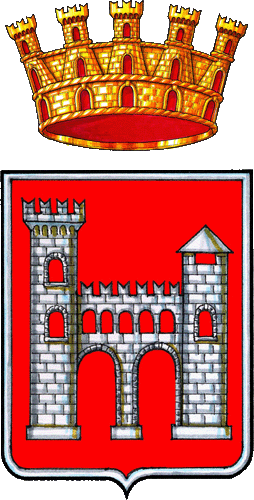
This is the coat of arms of the town my grandmother hailed from, Ascoli Pecino.
 Dusty Bookshelves